

A browser can click every expected button while the application saves the wrong record or leaves a signed out session usable.
Playwright end to end testing checks whether a person can complete a meaningful journey through a browser and the application services behind it. For a release decision, the useful evidence is the resulting product state, including rejected operations and recovery paths. A successful click sequence alone establishes little.
This guide proposes a workflow for teams maintaining web applications. Every illustrative scenario below is explicitly hypothetical and uses synthetic data. The official documentation supports tool behavior; the release criteria and investigation practices are recommendations, not reported test results.
Choose outcomes that justify a release gate
Write the product contract first
Describe the starting identity, permitted action, expected visible result, and durable outcome before writing browser automation. In a hypothetical team dashboard, an owner invites a collaborator. Success requires the invitation to belong to the intended workspace, remain visible after reload, and grant only the selected role.
Add a rejection case for a viewer attempting the same operation. Check both the explanation and the absence of a new invitation. Avoid counting pages visited or buttons clicked as coverage. Those measurements can increase while meaningful regression testing stays unchanged.
Keep the browser test suite selective
Choose journeys where navigation, rendering, authentication, and persistence interact. Keep detailed validation permutations in cheaper tests when the browser adds no distinct risk. Assign each e2e test an owner and explain which release failure it detects. Remove redundant journeys only after preserving their unique outcome checks.
For progressive releases, pair this plan with the feature flag testing guide so the tested configuration matches the intended audience.
Build a repeatable Playwright end to end testing workflow
Make each journey independently repeatable
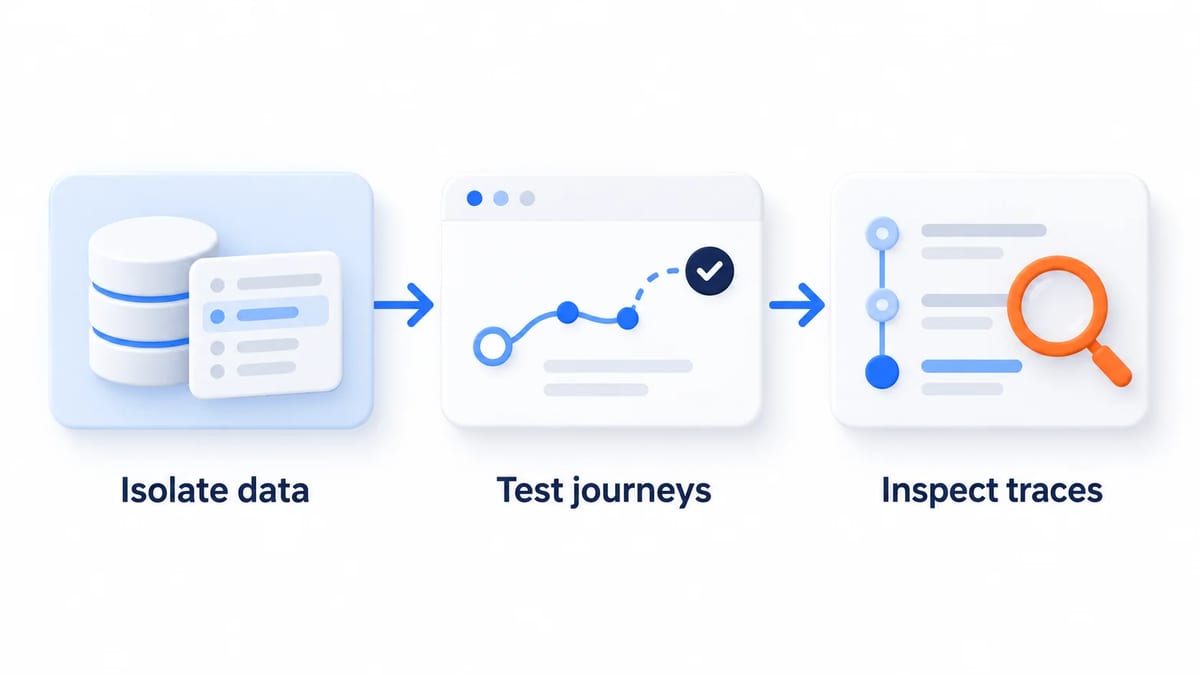
Use this ordered workflow for the selected release checks. Keep setup observable so infrastructure failures cannot look like application failures.
- Identify the candidate build, configuration, browser project, and target environment.
- Allocate distinct synthetic accounts and records for the run and parallel workers.
- Seed the minimum starting state and verify that setup completed.
- Open an isolated browser context with the required identity and settings.
- Complete the journey through stable locators and explicit readiness signals.
- Assert the visible outcome, persisted state, and prohibited effects.
- Retain permitted diagnostics, classify failures, and clean up owned resources.
Record fixture identifiers in restricted diagnostics. Cleanup should target those identifiers rather than delete everything matching a broad name. Failed setup needs its own failure category and enough evidence to repair it.
Separate setup from the behavior under test
Fixtures should own account allocation, data creation, and teardown. Small helpers can express repeated actions, but keep business assertions visible in the journey. A helper that silently dismisses errors or changes roles makes passing results difficult to interpret.
Use API setup where appropriate, while preserving the actual browser action being evaluated. Seeding an invitation is reasonable for an acceptance test; it would bypass the behavior in an invitation creation test.
Use Playwright locators that survive interface changes
Prefer roles and accessible names
Playwright locators support identifying controls by role, accessible name, label, and explicit test identifier. Operations targeting one element reject ambiguous matches. Prefer the user's semantic target over CSS ancestry or generated class names.
In a hypothetical dashboard with several Edit buttons, first locate the workspace row by its unique synthetic name, then locate Edit inside that row. Use exact names where similar labels exist. A dedicated test identifier is appropriate when the interface has no useful semantic distinction.
Treat ambiguity as evidence
Do not resolve a strictness failure by automatically choosing the first match. Investigate whether duplicate controls, hidden copies, or unclear naming changed the target. Positional selection is defensible only when order itself is part of the product contract.
Keep page objects small and organized around stable interface areas. Avoid wrapping every locator in an abstraction that hides the target or makes failures harder to read.
Wait for logical readiness and assert eventual outcomes
Distinguish actionability from application readiness
Actionability checks wait for conditions required by an action. For a click, these include a unique target that is visible, stable, enabled, and able to receive events. They do not establish that application initialization or business processing has finished.
The navigation guidance explains that hydration can leave an enabled control visible before event listeners attach. In a hypothetical server rendered form, typing before hydration could be lost. Fix the application so controls remain disabled until functional, then test that behavior rather than hiding it behind a delay.
Use web first assertions instead of arbitrary sleeps
Await retrying assertions for the expected text, URL, count, or enabled state. An immediate visibility snapshot followed by a Boolean assertion does not provide the same eventual check. Give each wait a bounded timeout tied to the operation's expected behavior.
Define completion before waiting
In a hypothetical export journey, a Ready status and a usable download belong in the completion contract. A quiet network or a vanished spinner alone cannot prove the file is correct. Check the artifact's expected synthetic content where practical. Register a download or response wait before the triggering action when missing the event would create a race.
Isolate identities and backend data during parallel testing
Browser isolation stops at the server boundary
A fresh browser context separates browser session state; it does not create a fresh database. Two contexts using the same account can still overwrite shared settings, consume one invitation, or exhaust one quota. Parallel testing amplifies those conflicts.
Allocate data with a namespace that includes the run, shard, browser project, and worker slot. Use distinct accounts for concurrently mutating tests. Worker fixtures can lease accounts, while test fixtures create fresh records within those accounts. Reset mutable state between journeys, and make teardown safe when setup only partially succeeds.
Treat fixture failures as release evidence
Verify initial state instead of assuming a seed request succeeded. If isolation is unavailable for a genuinely global setting, serialize that narrow group and document why. Reducing every worker to one may help diagnosis, but it leaves the ownership problem unresolved.
Protect authentication state and test signed out behavior
Reuse sessions with a defined boundary
Playwright authentication guidance allows saved browser state and recommends different accounts when tests modify shared server state. State files may contain impersonation credentials. Never commit them, including to private repositories. Generate short lived staging sessions and exclude their files from ordinary artifact uploads.
Limit account permissions to the journey. Keep a genuine sign in check separate from tests bootstrapped with saved state; reuse otherwise bypasses the login behavior. Validate expiration and avoid silently recovering a broken session in a way that conceals authentication failures.
Verify logout through negative checks
In a hypothetical account journey, sign out, revisit a protected URL, reload, and attempt the protected operation with the former session where revocation is part of the contract. Assert that private content and mutations are denied. A redirect to the login screen alone does not establish server enforcement.
Separate mocked behavior from real backend contracts
Give each testing layer an explicit purpose
Use controlled responses to exercise rare errors, empty states, or delays. Label these cases as frontend behavior checks. Retain a smaller integration testing set against the actual staging backend to verify request formats, authorization, persisted records, and deployed configuration.
For a hypothetical invitation failure, a mocked rejection can verify the recovery message. A real backend rejection must separately establish that no invitation was stored. Maintain mocks against the service contract so they cannot drift into an imaginary successful API.
Account for service worker routing limits
Playwright network documentation explains that service workers can make requests invisible to native page or context routing. Blocking service workers can help routing based tests, but changes the application behavior being exercised.
Keep separate service worker enabled checks for products that depend on caching or offline behavior. The PWA testing guide helps scope those lifecycle risks. Do not claim that an intercepted frontend response proves the real backend or service worker path works.
Investigate flaky Playwright tests and preserve traces
Classify intermittent failures before changing timeouts
The retry documentation classifies a first attempt success as passed, success after a failure as flaky, and exhausted retries as failed. Failed workers are replaced, so hooks and setup must tolerate repetition without duplicating external effects.
Investigate flaky tests by category. Locator ambiguity needs target repair; leaked records need isolation; readiness races need an observable completion signal; unavailable services need environment investigation. A genuine intermittent product defect belongs with the application owner. Attach evidence and a retest condition to temporary quarantines.
Current test runner configuration documents failOnFlakyTests, introduced in version 1.52, which makes flaky results produce an error exit. Verify support in the installed version and enable it when the release policy requires no flaky passes. Retries collect evidence; they should not silently redefine acceptance.
Inspect traces with a privacy policy
The Trace Viewer guide recommends on-first-retry for CI diagnostics. A retry trace records that attempt, which may differ from the original failure. Preserve first attempt logs and use focused tracing when the original event needs investigation. Without a retry, that setting produces no retry trace.
Restrict diagnostic artifacts
Use synthetic content, restrict report access, and set a retention period. Traces, screenshots, console output, and attachments can reveal private application data. Redact tokens and personal details in emitted logs and attachments before upload; do not assume log masking sanitizes trace archives. Check artifacts with synthetic secret markers and suppress captures that cannot be made safe.
Run Playwright CI checks across relevant browsers
Make the tested build reproducible
Pin the Playwright dependency through the lockfile and install the matching browser binaries. If using a container image, align its Playwright version. Record the build and environment identity so later diagnosis refers to the same candidate.
Use controlled web server startup with an explicit command, readiness URL, bounded startup timeout, and no reuse of an existing server in CI. Separately verify application dependencies and migrations. An answering HTTP endpoint does not prove the database is ready or the expected build is running.
In GitHub Actions or another CI system, bound workers to available resources, supply secrets through protected configuration, and publish restricted diagnostics even after test execution fails. Keep setup failures visible in the release decision.
Distinguish browser engines from real devices
Playwright browser documentation supports Chromium, Firefox, and WebKit projects. Its patched WebKit is not branded Safari, and platform dependent behavior can vary. Choose projects from supported audience risks and run the critical journey across them.
Mobile emulation is useful for viewport and input assumptions, but cannot establish behavior on physical iPhones or Android devices, including system keyboards and browser chrome. Supplement automation with real Safari and device checks where those differences affect the product.
Create a BetaRoast feedback round for people to evaluate clarity, confidence, and recovery on the visible journey. Human feedback can reveal confusion that passing assertions miss; it does not certify backend correctness or replace engineering release checks.
Frequently asked questions
What should a Playwright end to end test prove?
It should connect a browser action to a meaningful visible and durable outcome, including prohibited effects. Define the identity, starting state, and success contract first. Assert persistence after reload where relevant rather than stopping at a confirmation message.
Does a new browser context isolate the database?
No. Browser contexts separate browser state, while accounts and database records can remain shared. Allocate distinct mutable data for parallel workers and tests, verify starting conditions, and clean up only resources owned by the run.
Should a test that passes on retry allow a release?
Treat it as flaky evidence requiring investigation. Define the gate explicitly and use failOnFlakyTests when supported if flaky passes must block release. Classify the cause before increasing retries or timeouts, and assign ownership to unresolved failures.
Can WebKit and mobile emulation replace Safari device checks?
No. They provide useful automated coverage but do not reproduce branded Safari or every physical device behavior. Keep targeted real browser and device checks for risks involving platform integration, input, media, and the human experience.
Make browser release checks prove product outcomes with scoped locators, explicit readiness, isolated backend data, and protected authentication state. Separate mocked behavior from real integration evidence, investigate retries, and use traces safely. Combine browser engine coverage with real device checks and human feedback where automation cannot establish the experience.