

A flag can return the expected value while the wrong tenant receives the feature or a write crosses incompatible code paths.
Feature flag testing verifies that a feature toggle selects the intended behavior for the intended audience, including when configuration changes or evaluation fails. It connects flag decisions to application outcomes, not merely a Boolean assertion. Separating code deployment from feature release makes progressive delivery possible; it also introduces configuration, identity, and recovery risks.
This guide uses a hypothetical workspace application with synthetic tenants A and B. A new feature changes workspace creation and queues a welcome message. These are proposed test scenarios, not reported experiments. Vendor documentation establishes specific contracts; the workflow and release criteria are engineering recommendations.
Define feature flag testing scenarios and supported combinations
Start with observable outcomes
Specify which code paths each flag controls, its owner, safe default, dependencies, and removal condition. For workspace creation, assert the stored tenant, workspace format, response, and queued message. Verify that tenant B remains untouched. A passing flag evaluation cannot establish those outcomes independently.
Build a risk matrix
LaunchDarkly's testing guidance recommends selected configurations such as current production, intended production, fallbacks, and known problematic states rather than every theoretical combination. Apply that selection to supported combinations of feature flags. Record unsupported combinations and enforce their rejection or safe handling.
Current production checks regression risk. Existing workspace creation must remain valid.
New writer with a compatible reader checks changed data. Both supported readers must understand the resulting records.
New writer without its prerequisite checks invalid combinations. No incompatible write may occur.
Evaluation failure checks unsafe fallback. The defined default must preserve application invariants.
Multivariate configuration checks invalid parameters. Every supported value must validate before use.
Pairwise coverage can supplement this matrix, but dependencies and irreversible operations deserve explicit cases. Include empty, missing, and malformed structured values where the application accepts multivariate flags.
Build a repeatable feature flag testing workflow
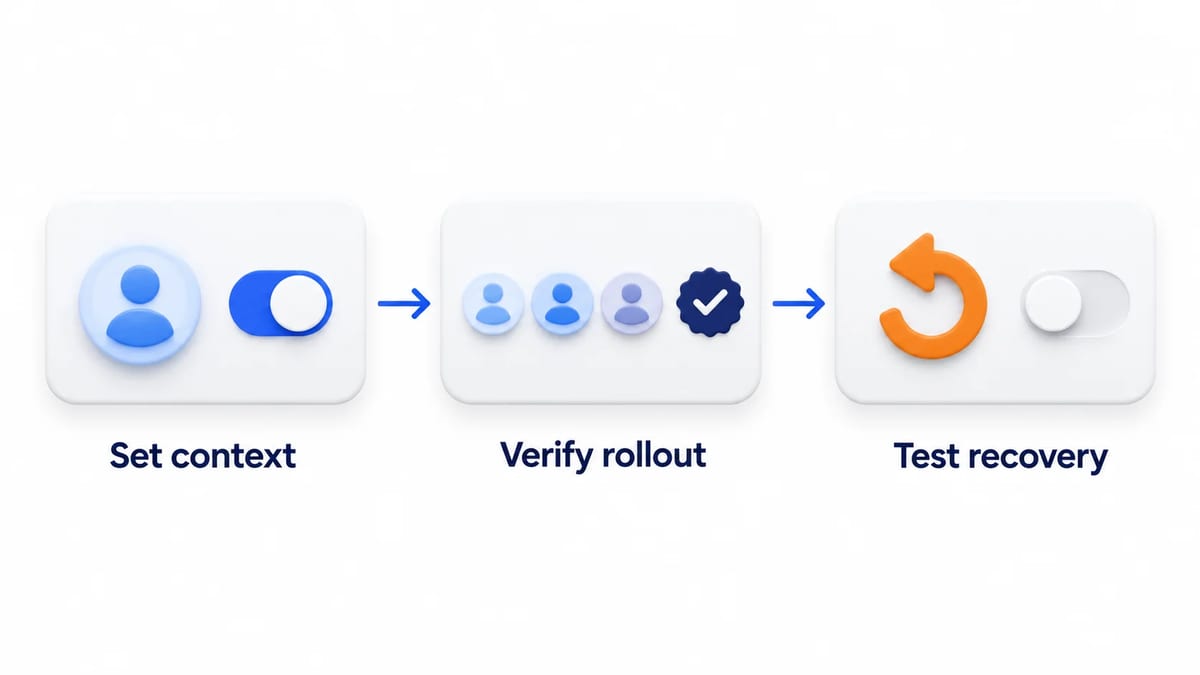
Control the test environment
Version the application build, SDK, provider adapter, flag configuration, and synthetic fixtures together. Record the evaluated context shape and expected outcome. Separate staging credentials from production and give each parallel run distinct tenant records, queue captures, and configuration namespaces where supported.
- Restore synthetic records and confirm their initial state.
- Apply a supported configuration and await documented readiness.
- Evaluate with a trusted, explicit context.
- Complete the user action through the real application boundary.
- Inspect stored state, queued work, and prohibited effects.
- Change configuration at a defined boundary and repeat.
- Restore overrides and dispose of test resources.
Prove the checker detects failures
Add a negative control that reports success while storing a workspace under tenant B. The outcome checker must fail. Another control skips the welcome job. This verifies that automated testing observes business state rather than trusting the handler's response. Keep expected results independent of the implementation selecting the branch.
Test default flag values and provider lifecycle states
Separate successful evaluation from failure
The OpenFeature evaluation API requires a caller supplied default and returns that default on abnormal evaluation without propagating evaluation exceptions. Detailed results expose error codes; other metadata can be best effort. Test missing flags, type mismatches, and provider failures against the chosen default.
A successful off variation and an error returning false can look identical through a value only API. Inspect details and outcome together. Do not infer an error merely because the returned value equals the default. Configuration and setup failures need separate handling from evaluation calls.
Distinguish readiness from freshness
The OpenFeature provider contract covers provider errors, including not initialized and irrecoverable conditions. Its event specification distinguishes readiness, error, stale configuration, and context reconciliation signals. Test the implemented SDK and provider behavior for each supported state.
Stale configuration is a separate decision
A stale provider may still evaluate cached rules successfully. It does not universally force the caller default. Define an application freshness policy for sensitive writes, test cache expiry and reconnection, and measure the actual provider behavior. Likewise, provider ERROR status is not proof that every evaluation returned its default; inspect each relevant result. Use bounded readiness waits and explicit failure outcomes instead of arbitrary sleeps.
Validate context identity and tenant isolation
Define the targeting subject
Decide whether rollout membership belongs to a person, session, or workspace. Use a stable synthetic identifier and derive tenant and entitlement attributes from trusted server state. A browser supplied tenant parameter cannot establish ownership. Test anonymous visitors, sign in, sign out, tenant switching, and identical user identifiers in different tenant namespaces.
Scope context to the request
OpenFeature's context specification defines context merging and transaction propagation for supported dynamic context SDKs. Invocation data and hooks can override lower levels. Inspect the final effective context and verify that trusted fields cannot be replaced by untrusted input.
Interleave requests for tenants A and B at asynchronous boundaries. Assert that neither request inherits the other's identity. Avoid mutating global user context on a shared server. Use invocation context or supported request propagation, then test cleanup after exceptions. For static context clients, test reconciliation during account switches before accepting another user's cached decisions.
Verify deterministic cohorts during progressive rollouts
Test stickiness with fixed identities
Unleash stickiness documentation describes hashing a context field with the strategy group identifier. Its default selection uses user identity, then session identity, and becomes random when both are absent. Confirm repeated decisions across restarts and supported devices with the configured identity. Missing identity must trigger your documented behavior, not an assumed stable cohort.
Increase the rollout while preserving group identifier, context, and other rules. Check membership for fixed synthetic subjects before and after the change. Then deliberately change the group identifier and verify that tests detect reassignment. A small fixture set cannot prove an exact population percentage.
Verify the complete targeting configuration
Unleash activation strategies combine strategies with OR logic and constraints within a strategy with AND logic. An unrestricted second strategy can therefore defeat an intended tenant restriction. Test eligible and ineligible tenants through every configured strategy.
LaunchDarkly percentage rollouts use context key and kind in bucketing. Providers differ in hash inputs and allocation rules. Treat cohort hashes as provider specific, not portable across vendors or SDK adapters. During migration, compare assignments explicitly or preserve them through an approved mapping rather than assuming equivalent percentages mean equivalent users.
Include a context kind mismatch fixture. LaunchDarkly documents that a context matching a rollout rule but using a different kind from its rollout receives the first variation with a nonzero allocation. Send a synthetic device context into a user rollout and assert the intended exposure policy. Restrict targeting explicitly when such contexts must remain ineligible; a percentage setting alone cannot establish that exclusion.
Keep frontend and backend decisions consistent
Establish a decision boundary for writes
Prefer a server authoritative decision for the workspace mutation. Evaluate related flags from a coherent snapshot when the provider supports one. Otherwise, define an application strategy for detecting configuration changes or selecting one validated operation mode. Separate sequential evaluations are not automatically atomic.
Configuration changes during a write
Pause creation after validation, change the flag, then resume before persistence and job enqueueing. Assert that one supported mode governs the operation. Do not let one decision validate the old schema while another writes the new schema. Retries need a persisted operation mode or a documented compatibility rule.
The frontend can receive the server's permitted presentation state, but that state must not authorize a mutation. Test stale tabs, server rendered bootstrap data, hydration, and refresh after a flag change. If browser and server evaluate independently, verify identity mapping and configuration freshness explicitly.
Keep authorization independent
OWASP authorization guidance recommends permission checks on every request. Test a direct backend request while the new feature is hidden, and an unauthorized request while its flag is enabled. Both paths must enforce tenant ownership and permissions. Neither cohort membership nor a disabled button grants or revokes access control by itself.
Combine isolated tests with real SDK integration testing
Keep overrides local and temporary
Unit tests can inject decisions to cover branch behavior deterministically. Integration testing should also exercise the installed SDK and adapter. Use separate API instances where implemented, dependency injected providers, or process isolation. Named domains alone do not isolate shared provider objects or global hooks.
Restore overrides in guaranteed teardown, including failed assertions. Remove event listeners, clear context, stop timers, and close clients. Never shut down a shared singleton while another parallel test uses it. Run cases in different orders to expose leaked state before adding retries that might conceal contamination.
Exercise actual staging configuration
Use SDK test data or supported local configuration for controlled failures, then retain a small end to end testing suite against the real staging service. Verify environment keys, prerequisites, segments, targeting attributes, streaming or polling, and reconnect behavior. Mocks cannot detect a wrong environment key or a missing deployed rule.
In continuous integration, keep configuration stable for each run and serialize mutations when isolation is unavailable. Pin test inputs, bound waits, and report configuration drift as a failure. Do not silently convert a failed integration check into a skipped release gate.
Rehearse kill switches rollback and background jobs
Disable future exposure deliberately
A rollout flag controls exposure; a kill switch stops a defined operation. Document which one operators should disable, who is authorized, and how cached clients receive the change. Rehearse the action in staging with permitted operators and synthetic records. A disconnected client may not receive a remote kill switch promptly.
Disabling does not undo effects
Turning a flag off does not reverse committed records, sent messages, or external side effects. Code rollback also needs compatible data. Propose explicit repair or compensation procedures and verify them separately. Avoid destructive schema removal while old readers or retained jobs still depend on it.
Preserve a defined job lifecycle
Queue work under the new mode, disable the flag, and restart the worker. Decide whether accepted jobs complete using their recorded mode, pause for review, or cancel safely before effects. Test retries after partial completion with stable idempotency keys. Rechecking a live flag cannot by itself make cancellation or replay safe.
Run older queued payloads through the candidate worker and newer records through any supported rollback build. Expand schemas compatibly, migrate deliberately, and remove legacy fields only after readers and jobs no longer require them.
Gate release testing with observability and flag hygiene
Observe decisions without exposing identity
Record build, environment, flag key, variant, available reason, provider status, and a restricted correlation reference. Separate evaluation errors from business failures. Monitor fallback rate, configuration freshness, write failures, and queue backlog by rollout cohort where feasible. Define pause thresholds and owners before canary testing begins.
The OWASP logging guide recommends protecting sensitive log data. Avoid dumping evaluation contexts, tokens, or emails. Test redaction using synthetic secret markers and sanitize untrusted fields. Sampling and bounded metrics help prevent evaluation telemetry from overwhelming hot paths.
Validate the visible journey and retire flags
Require passing isolation, fallback, compatibility, staging, and recovery checks before increasing exposure. Retest after material feature flag changes. Assign expiry reviews, remove abandoned overrides, and delete retired branches only after confirming deployed clients and jobs no longer need them. This flag hygiene keeps future matrices manageable.
For browser lifecycle coverage, use the PWA testing guide. Ask human testers to complete creation, interpret pending states, and recover from a visible interruption using synthetic accounts. Collect reproducible steps with the mobile app bug report guide. Create a BetaRoast feedback round for that human journey; engineers own provider fault injection and configuration verification.
Frequently asked questions
What should feature flag testing cover beyond on and off states?
Cover supported variants, defaults, evaluation failures, stale configuration, identity transitions, dependencies, and application outcomes. Include configuration changes during writes and queued work. Correct values alone cannot establish safe tenant ownership or compatible stored data.
Must every combination of feature flags be tested?
No. Define supported configurations and prioritize current production, intended release, fallback behavior, dependencies, and high impact interactions. Use broader combination coverage where useful, but explicitly reject unsupported states instead of assuming they never occur.
Can a feature toggle replace backend authorization?
No. A toggle selects behavior or exposure. The backend must authenticate requests and authorize the specific operation and tenant independently. Test direct requests and stale clients even when the interface hides the feature.
Is disabling a flag the same as a rollback?
No. Disabling affects subsequent decisions subject to propagation and application policy. It does not undo persisted data or external effects. A code rollback requires schema and job compatibility; repair or compensation needs a separate verified procedure.
Test flag values alongside provider health, trusted context, supported combinations, and resulting state. Keep authorization independent, verify the real staging configuration, and rehearse disabling future work without assuming it reverses committed data or external effects. Use human feedback to validate the visible journey after engineering checks pass.