

A correct 429 response can still hide an unfair quota, an unsafe retry, or duplicated work.
API rate limit testing checks whether a service admits and rejects requests according to its contract, then recovers without unsafe retries or unfair resource allocation. Seeing HTTP 429 proves only that one request was rejected. It does not establish which quota applied, whether admitted work completed, or whether the next attempt is safe.
This guide uses a hypothetical workspace service with tenant scoped creation and export endpoints. All scenarios are proposed tests with synthetic data, not field results. Run them in an authorized staging environment with bounded load, fake outbound services, and explicit stop conditions. Never flood production to discover a limit.
Define the quota contract before generating traffic
Specify scope algorithm and accounting
Record whether each budget applies to an authenticated user, tenant, credential, endpoint, region, or entire service. State the algorithm, window duration, refill rate, burst capacity, request cost, and clock source. A fixed window can admit two adjacent bursts around reset; a sliding window and token bucket have different boundaries.
For the fictional creation route, propose five admitted attempts per tenant in each aligned ten second window. Rejected attempts do not consume this budget; retries that are admitted do. Separately specify whether validation failures, business failures, and idempotent replays consume quota. These choices are policy, not consequences of the status code.
Include expensive work within the budget
An export may consume more resources than a metadata read. Define weighted costs and additional concurrency or queue limits where required. OWASP's resource consumption guidance covers limits on execution time, payload size, batching, and other resource use beyond request frequency. Test a large permitted export and a batch of operations; counting each HTTP envelope once may leave expensive work effectively unlimited.
Build a repeatable API rate limit testing workflow
Isolate state and observe application effects
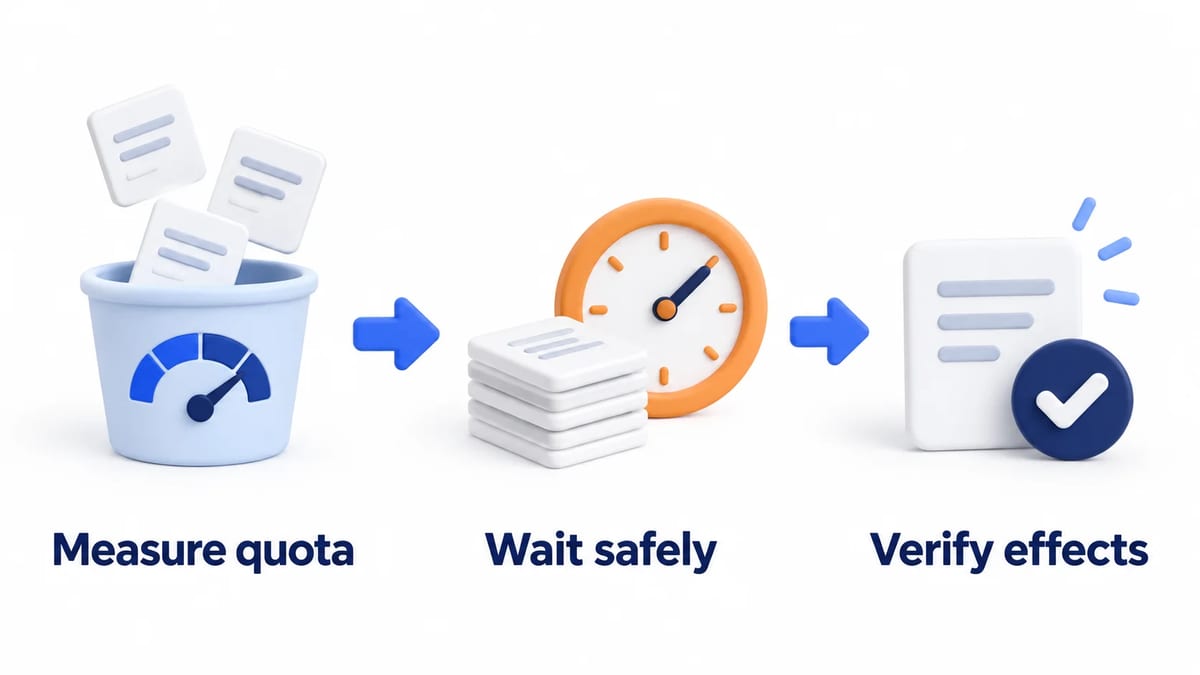
Give each run dedicated tenant fixtures, quota namespaces, synthetic credentials, and resource records. Start with empty queues and known counters. Capture a redacted request identifier, trusted scope, admission decision, response, and completion outcome. Keep credentials out of recordings and reports.
Exercise the real HTTP route through authentication, middleware, limiter, storage, and worker. A direct limiter call is useful locally but cannot prove deployed routing or business effects.
- Restore the fixture and load its explicit quota policy.
- Schedule requests with known identities, costs, and timing.
- Record admission, rejection, and HTTP response separately.
- Inspect persisted work and completed resource state.
- Execute the specified retry or recovery scenario.
- Assert both intended effects and prohibited changes.
Prove the harness detects incorrect admission
Use a negative control that bypasses the limiter. The over budget assertion must fail. Another control returns success without creating the workspace; completion assertions must fail independently. These checks prevent a green status counter from becoming your only release evidence.
Test identity isolation and fairness explicitly
Derive keys from authenticated context
Build tenant keys from verified identity and authorized membership. An arbitrary tenant header must not select another customer's quota. Send a valid tenant A credential with a forged tenant B header and confirm the intended rejection or trusted mapping. Check that credential rotation cannot reset a tenant budget when the contract scopes it to the tenant.
Authentication and authorization remain independent of rate limiting. Below quota requests with invalid credentials or forbidden workspace access must still fail. Where preauthentication abuse controls exist, give them separate keys and tests rather than treating an IP allowance as proof of identity.
Declare the noisy neighbor policy
Run tenant A aggressively while tenant B sends ordinary requests. Assert B's declared admission and latency budget while checking any shared service ceiling. Per tenant quotas alone cannot guarantee fairness if both tenants saturate the same worker pool.
For IP based controls, simulate users behind one public address and changing network addresses. Private IPs are not globally unique identities. Trust forwarded address metadata only through a configured trusted proxy boundary. Decide explicitly whether shared networks receive a shared allowance or authenticated users receive individual allowances.
Separate deterministic boundaries from real integration
Control the clock for exact assertions
For the proposed fixed window, freeze time and admit five requests for tenant A. Assert the sixth is rejected and causes no workspace creation. Repeat a rejected request and inspect accounting. Advance to immediately before reset, exactly reset, and immediately after reset; assert the documented inclusive or exclusive rule.
For a token bucket, specify capacity and refill precision instead of reusing fixed window expectations. Exhaust tokens, advance less than one token interval, and test the exact refill boundary. Include a request costing more than remaining capacity and one costing more than total capacity. Ensure rejection cannot produce negative tokens.
Validate deployment behavior without exact timing assumptions
Controlled clocks expose algorithm defects. Real staging integration covers proxy behavior, clock skew, network delays, and runtime bindings. Observe server timing and configured consistency rather than assuming a client sleep lands precisely on a reset. Keep exact unit assertions and distributed integration expectations separate, with an explicit measurement interval and drain period.
Verify atomic decisions and distributed scope
Race requests against the same remaining allowance
Release concurrent requests through a barrier when one admission remains. For a strictly serialized single authority, require one admission and no duplicate counter updates. Test counter initialization, expiry, and restart alongside that race.
Redis's INCR documentation describes counter rate limiter patterns and a race between incrementing a counter and applying expiry. An atomic increment does not make the whole admission workflow atomic. Use a suitable transaction or script for the required decision and expiry semantics, then test failures between operations. Do not assume atomicity also supplies durability or cross region coordination.
Match assertions to the actual enforcement domain
Cloudflare's Workers rate limiting binding applies its allowance within a Cloudflare location. Its cached counters update asynchronously; enforcement is permissive and eventually consistent, not accurate accounting. A shared key does not establish a strict global quota.
Requests across multiple regions
Send the same synthetic tenant through authorized regional paths and record the actual serving locations. Specify whether the product promises independent regional budgets, approximate aggregate protection, or a coordinated global ceiling. Compare observed behavior with that architecture. If strict global admission is required, test the coordinating authority and its partition behavior; a local counter cannot establish that guarantee.
Check rejection responses and cache behavior
Validate 429 without inventing extra requirements
RFC 6585 defines 429 and permits an optional Retry-After header. It does not prescribe how users are identified or requests counted. Assert your documented error body and any promised headers, including a useful recovery explanation without secret scope identifiers. A missing optional header is not automatically a protocol failure.
RFC 6585 also requires that caches must not store 429 responses. Exercise the deployed CDN and proxy path. Exhaust A, then send an eligible request from B and verify a fresh decision. Repeat after A's quota recovers. Configure and inspect cache bypass behavior rather than assuming an origin response alone proves compliance.
Parse both supported retry delay forms
RFC 9110's Retry-After definition supports a nonnegative integer delay in seconds or an HTTP date. Test both, including zero, a past date, clock skew, missing values, malformed text, negative numbers, fractions, and overflowing integers. Validate syntax before converting values into timers.
For invalid or absent values, apply a documented bounded fallback. If a valid server delay exceeds the operation deadline, stop or defer the operation; do not shorten the delay and retry early. Provider specific quota headers require their own contract and should not be presented as universal RFC requirements.
Make retries bounded and safe for ambiguous outcomes
Budget attempts time and retry amplification
Define maximum attempts, elapsed deadline, cancellation, and a capped backoff policy. AWS's backoff and jitter guidance explains how randomized delays spread retry contention. Test many clients receiving rejection together, using deterministic randomness locally and observing actual retry spacing in staging.
Honor valid server delays, adding jitter without retrying earlier than the permitted time. Ensure layered clients and workers do not multiply independent retry loops. Retry only eligible failures under the endpoint contract; authentication failures and invalid input need correction rather than repeated traffic.
Resolve uncertainty before repeating mutations
Do not automatically retry a nonidempotent request without an explicit safety contract. A timeout after commit leaves the client uncertain even if the server created the workspace successfully.
Connection loss after the workspace commits
Commit the workspace, lose the response, and repeat the operation using the same supported idempotency identity. Assert one resource and a reconciled result. Also test concurrent duplicates, changed parameters, key expiry, and trusted tenant scoping. A new key for each retry defeats deduplication.
Stripe's idempotent request documentation illustrates why provider versions matter. Its API v1 retains the first executed response for a key, including errors, with parameter checks and retention rules; API v2 has different retry semantics. Apply the workspace service's own documented behavior. Idempotency and quota accounting must also agree on whether replayed responses consume allowance.
Measure offered admitted and completed work
Account for the traffic the generator actually sends
Record scheduled demand, actual offered requests including retries, admitted requests, rejected requests, and completed logical operations as separate rates. Report latency for admissions, rejections, and end to end completion independently. Fast rejections can conceal slow accepted work in an aggregate percentile.
For each load test, label HTTP attempts in requests per second and completed operation throughput separately. A quota expressed in requests per minute still needs its declared window semantics; converting units does not make a fixed window behave like continuous refill. Keep those units and measurement intervals consistent across the test suite and release report.
Grafana's arrival rate guidance describes scheduling iterations with sufficient virtual users. A k6 iteration is not necessarily one HTTP request. A workflow may send several requests and retries. Count actual attempts explicitly.
The k6 metrics reference defines dropped_iterations for iterations that never started. Account for them when evaluating scheduled load; dropped work is neither server rejection nor completed demand. Inspect generator capacity and service slowdown before interpreting a lower offered rate.
Gate correctness separately from expected rejection
k6 thresholds can fail a run; checks alone do not determine its exit status. Use separate metrics and thresholds for valid expected 429 responses, unexpected statuses, prohibited side effects, completion, and admitted latency. Never mark every error response successful merely because the scenario intentionally exceeds quota.
Limiter dependency outage and recovery
Inject counter store timeouts and unavailability under a small bounded load. Define fail open, fail closed, or a limited local fallback per endpoint. Fail open can increase downstream exposure; fail closed can block legitimate work. Verify authentication still applies, responses describe the actual failure, alerts fire, and recovery restores accounting. Neither policy supplies universal availability or safety guarantees.
Use the webhook testing guide when admitted work triggers asynchronous delivery. Capture reproducible evidence with the mobile bug report guide. For human feedback, create a BetaRoast testing round focused on the visible queued, waiting, cancelled, and completed experience using synthetic accounts.
Frequently asked questions
What should API rate limit testing prove?
It should prove the declared admission policy, trusted scope isolation, accounting, rejection behavior, and safe recovery. Assert completed effects independently, including the absence of effects for rejected work.
Must every 429 include Retry After?
No. The header is optional under RFC 6585. Test it when your service promises it, and define bounded client behavior when it is missing or malformed.
Can a single location test prove a global quota?
No. It validates only the exercised enforcement domain. Global assertions require the documented coordination architecture and tests across relevant locations, including concurrency and partition behavior.
Is it safe to retry a timed out creation request?
Only under an explicit idempotency or reconciliation contract. A timeout may follow a successful commit. Reuse the supported operation identity and verify the existing result before risking another mutation.
Define the quota contract, test exact boundaries with controlled time, and verify the deployed path under bounded staging load. Measure admission separately from completion, preserve tenant isolation, and require safe retry behavior through ambiguous outcomes and dependency failures.