
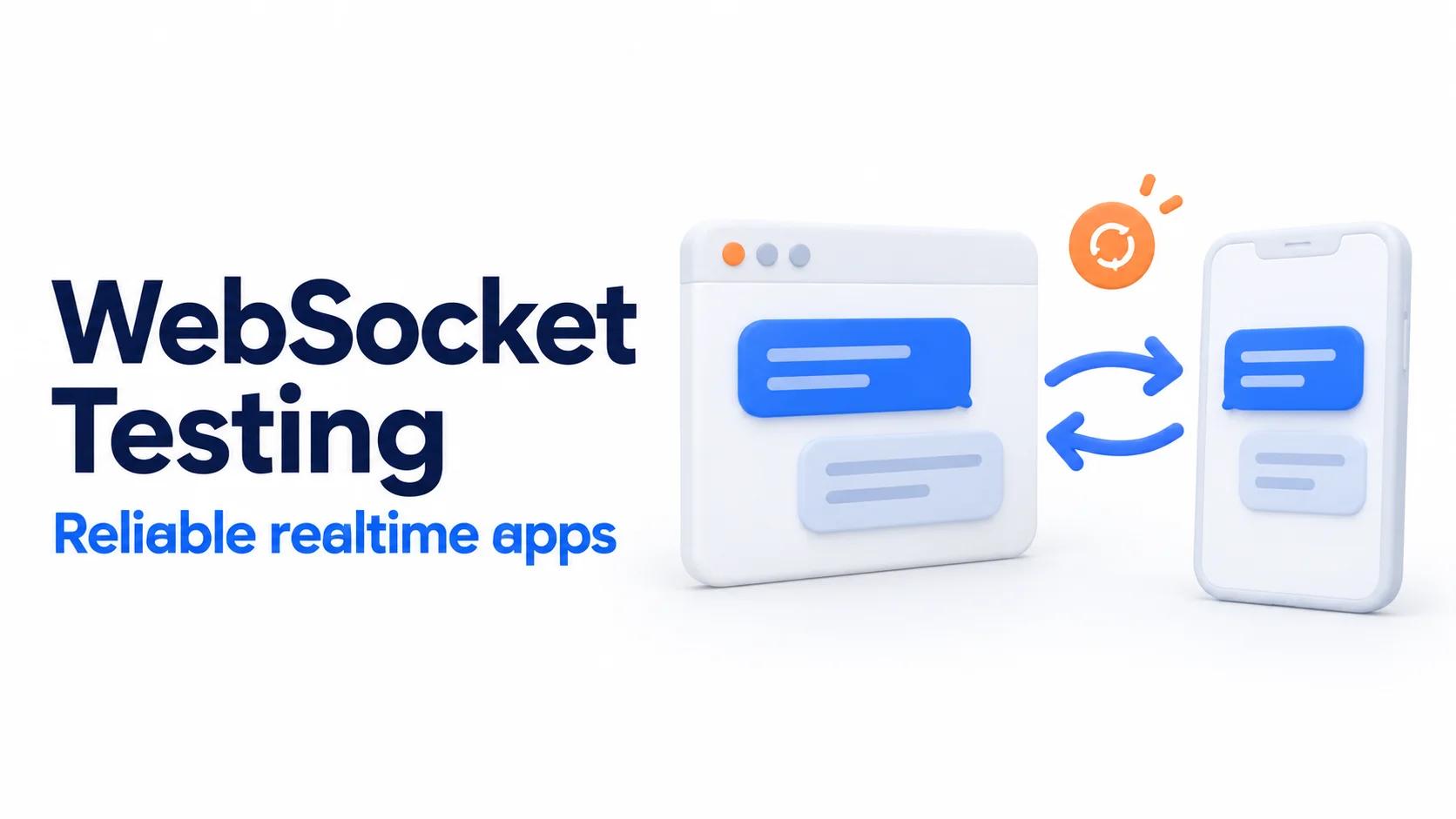
An open socket proves connectivity. It does not prove that the user's action was saved or that reconnecting restored the right state.
WebSocket testing establishes whether a realtime application exchanges valid messages, enforces access, and recovers without losing or duplicating business effects. A successful connection is the beginning of that evidence. Chat, collaboration, live dashboards, and notifications also need explicit rules for acknowledgments, subscriptions, and state reconciliation.
This guide connects browser checks with server integration, recovery, and bounded performance testing. All example scenarios are hypothetical design cases, not reported experiments or measured results. The recommendations reflect official documentation reviewed on October 14, 2026.
Separate protocol behavior from application delivery
Define what each acknowledgment actually proves
RFC 6455 defines the handshake, message framing, and control frames. Messages can span multiple frames, so a frame count is not a business event count. The protocol does not define your application's persistence acknowledgment, replay history, or retry semantics.
Write an application contract before building assertions. Name message types, schema versions, correlation identifiers, authorization requirements, and error bodies. Distinguish received, accepted, committed, and published outcomes. Decide which acknowledgment permits the interface to show success, and what the client does when that acknowledgment never arrives.
In a hypothetical chat service, a send acknowledgment might mean the server queued a message or that storage committed it. Those are different promises. Test the promised storage boundary and the recipient's view, including rejection bodies. An acknowledgment containing the wrong conversation or message identifier must fail the test even if its type looks correct.
TCP ordering applies within a connection, not across reconnects or different connections. Your application must define ordering for merged streams and concurrent processing. A sequence gap indicates missing application history only when the sequence contract defines its scope and continuity; filtered streams and multiple partitions need different rules.
Build a repeatable WebSocket testing workflow
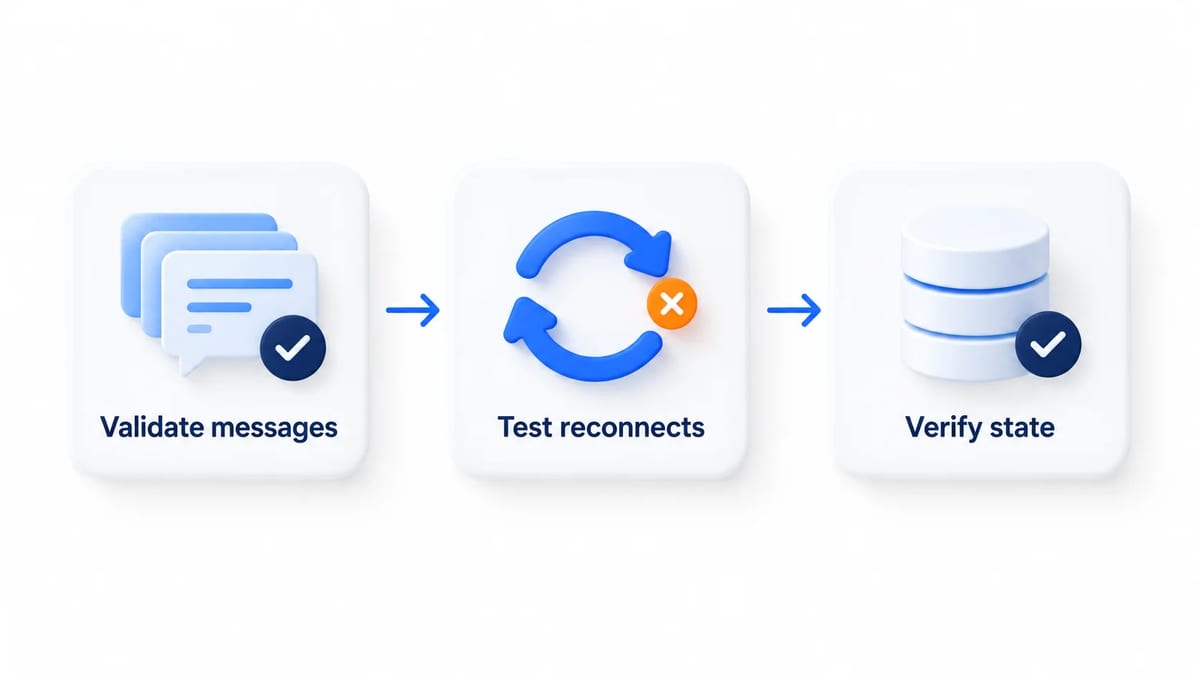
Follow one action through interruption and recovery
Validate WebSocket messages against the application contract
Use fixtures for supported versions, missing fields, invalid types, unknown operations, and malformed JSON. The MDN message event reference explains that event data is a string for text messages and a Blob or ArrayBuffer for binary messages, depending on binaryType. Exercise the encoding your product actually uses.
Assert the complete relevant response body and correlation identifier. Rejection should leave durable state unchanged and disclose no protected fields. For accepted commands, read the resulting resource through an independent API or storage assertion. An echo server is useful for connectivity diagnostics but cannot establish your business contract.
Test reconnects at specific failure boundaries
In a hypothetical task app, interrupt the connection after a command reaches the server but before its acknowledgment reaches the client. Retry with the same idempotency identifier. The expected outcome is one stored task and a response identifying that same task, according to the documented deduplication policy.
Give each interruption a bounded deadline and explicit expected result. Test before send, during processing, after commit, and during replay separately. Avoid fixed sleeps as evidence of recovery. Wait for observable subscription readiness and authoritative state, and fail when either misses the deadline.
Verify state beyond the socket
Compare the client's final state with the authoritative resource and expected event history. Record the initial version, applied cursor, and final version. Check that counters, notifications, and other side effects occur only as promised. Verify another authorized client when collaboration is part of the contract.
Include negative assertions for duplicate subscriptions and late events after logout. Make the absence check meaningful by first demonstrating delivery to an authorized control client, then waiting through a defined observation window. A silent socket with no confirmed publisher activity is weak evidence.
Test WebSocket connection setup and authorization
Exercise the actual browser credential path
The MDN WebSocket constructor documentation exposes a URL and optional subprotocols, not an arbitrary headers option. A Node client capable of setting an Authorization header does not reproduce that browser path. Test the actual cookie or application authentication design and inspect the negotiated protocol before sending versioned messages.
Include missing credentials, expired credentials, unsupported subprotocols, and authentication timeout. If authentication occurs through a message after opening, protected subscriptions and data must remain unavailable until validation succeeds. Keep credentials out of URLs and logs where possible, and redact message captures used as evidence.
The OWASP WebSocket security guidance recommends WSS, explicit Origin validation, session invalidation, and authorization for individual actions. Test denied origins with a browser and also use a nonbrowser client to demonstrate that forging an allowed Origin cannot bypass authentication. Origin is a browser security signal, not proof of identity.
Use synthetic identities in separate tenants. Attempt to subscribe to another tenant's room and mutate its resource. Assert denial, no broadcast, and no durable change. Revoke access while connected and verify subsequent actions and protected outbound delivery stop. Define the revocation boundary so an already delivered message is not confused with a later leak.
Distinguish WebSocket heartbeat failures from lifecycle changes
Test graceful closure and abrupt loss separately
The official ws server examples use Ping and Pong to detect broken connections and terminate unresponsive peers. Their termination path differs from a graceful close handshake. In an isolated test environment, exercise graceful shutdown, forced socket termination, and a network blackhole independently.
Browser JavaScript cannot send or observe native Ping and Pong control frames through the WebSocket API. The websockets keepalive documentation explains why browser clients may need an application heartbeat to notice a broken path. Define that heartbeat's reply and timeout, then suppress replies to test detection and cleanup.
Backgrounding a phone, locking its screen, killing the app process, and force closing a server socket are distinct conditions. The Page Visibility API documentation identifies visibility changes, but a hidden page is not proof of process suspension or network loss. Verify actual lifecycle behavior on supported devices. After resuming or restarting, reconcile state before presenting stale content as current.
Interpret close codes without inventing signals
Record code, reason, and wasClean as documented in the MDN close event reference. These describe closure; they do not establish whether the last command committed. Recover that answer through the application contract.
RFC 6455 close code rules reserve 1006 for reporting abnormal closure, so never send it in a Close frame. Private application codes belong in 4000 through 4999 and require agreement between client and server. Document which authentication closures stop retries and which allow credential refresh.
The MDN close method reference limits explicitly supplied browser codes to 1000 or 3000 through 4999, and reasons to 123 UTF8 bytes. Use valid inputs in closure tests. An exception from an invalid close call does not simulate a remote disconnect.
Test WebSocket reconnects and restore durable state
Bound retries and make replay an explicit contract
Use capped exponential backoff with jitter and a retry budget. Reset it after meaningful stability rather than every brief open event. Stop retries after logout or terminal authorization failure. Test repeated outages with controlled time and randomness, then verify the client avoids simultaneous reconnect attempts.
Persist the last applied replay cursor at the boundary your product promises. Deduplicate replayed event identifiers, and enforce sequence scope consistently. Define retention limits and an explicit response when a cursor is too old. A reconnect can restore transport while leaving the interface permanently incomplete.
In a hypothetical dashboard, an expired cursor triggers a full snapshot with a version boundary. Buffer or reconcile subsequent events around that boundary, discard older updates, and request recovery when a meaningful gap remains. Simply fetching a snapshot and then subscribing can miss changes between those operations.
Attach a connection generation or epoch to asynchronous work. A delayed snapshot from an earlier connection must not overwrite newer state. In a hypothetical reconnect test, delay that response until the new connection has applied newer events and verify it is ignored. Recreate each authorized subscription once, remove old listeners, and cancel pending callbacks when the user leaves or logs out.
Test buffering and enforce resource limits
Measure each queue in the direction it serves
The MDN WebSocket API reference warns that the classic API provides no automatic backpressure. Fast incoming messages can overwhelm processing or memory. Test a bounded burst while deliberately slowing consumer work, and inspect queue growth, responsiveness, and recovery.
MDN bufferedAmount documentation defines bytes queued by send that have not yet reached the network. It is an outbound indicator, not an incoming backlog measurement. Instrument application processing queues and server send queues separately. Set limits with a documented policy for pausing, rejecting, coalescing, or disconnecting.
The MDN send reference explains that send enqueues data, throws while connecting, and silently discards data while closing or closed. Exercise those transitions and retain unresolved commands according to the retry policy. A successful send call is not a delivery acknowledgment.
Test payload size boundaries, message rates per identity, connection ceilings, and authorized room counts with isolated accounts. Assert the configured rejection and bounded cleanup. Include decompressed payload limits if compression is enabled. Run flood and saturation cases only in a controlled environment with explicit stop conditions.
Choose WebSocket testing tools by evidence needed
Combine deterministic mocks with real integration
Playwright routeWebSocket, introduced in version 1.48, routes only sockets created after registration. Register it before navigation creates the page's connection, and handle future reconnect connections too. Use deterministic messages to verify pending, rejected, stale, and recovered interface states. Confirm the installed version supports the API.
The WebSocketRoute reference distinguishes a full mock from connectToServer forwarding. Installing onMessage replaces automatic forwarding in that direction, so explicitly forward messages when interception should preserve delivery. An accidental dropped message can manufacture the failure you think you discovered.
Mocks do not establish real server authorization, storage, proxy behavior, or load capacity. Keep integration coverage through the actual deployment path using synthetic tenants. Verify upgrade routing, idle timeout behavior, message bodies, durable effects, and subscriber delivery together.
For bounded load testing, Grafana's current k6 websockets documentation describes k6/websockets with a global event loop, unlike legacy k6/ws. Pin and verify your installed k6 version and module before adapting examples. Model connection lifetimes, fanout, payload distribution, and reconnect waves; measure completed application outcomes alongside generator headroom. No load run was performed for this guide.
Use the Playwright testing guide for browser evidence and the k6 load testing guide for workload validity. Preserve versions, fixtures, connection epochs, cursors, close observations, and redacted timestamps when investigating regressions.
Finally, create a BetaRoast feedback round with safe accounts and a hypothetical mission involving interruption and recovery. Ask people whether pending work, reconnect indicators, and retry choices are understandable. BetaRoast supports human user feedback. Engineers own automated WebSocket checks, protocol diagnostics, and performance evidence.
Frequently asked questions
What should WebSocket testing verify beyond a connection?
Verify message schemas, correlated acknowledgments, authorization, durable effects, and state after interruptions. A connected socket cannot establish that a command committed or that every subscriber received the right event.
Does WebSocket preserve ordering after reconnecting?
A new connection does not continue the previous transport's ordering guarantee. Define application sequence scope, replay cursors, deduplication, and snapshot boundaries. Test delayed work from older connections so it cannot overwrite newer state.
Can browser JavaScript send WebSocket Ping frames?
The browser WebSocket API does not expose native Ping or Pong controls. Use a defined application heartbeat when browser code needs liveness evidence, and test mobile backgrounding separately from network interruption.
Can Playwright mocks replace real WebSocket integration tests?
Mocks verify controlled client behavior. Real integration tests must establish server access rules, persistence, deployment routing, and recovery. Performance tests add bounded workload evidence, while human feedback evaluates whether users understand the experience.
Reliable WebSocket testing verifies message contracts, authorization, durable effects, and recovery across connection boundaries. Combine deterministic browser mocks with real server integration and bounded load evidence. Use BetaRoast for human feedback on visible waiting and recovery states while engineers own automated checks and release decisions.