

A checkout test passes alone and fails beside another worker because both spend the same account balance. The fixture needs an owner and a reset contract.
A checkout test passes alone. In the full suite, another worker spends the same account balance first, and checkout reports insufficient funds. Retrying sometimes passes because the starting state changed again. The failure becomes understandable once you can identify who owns the account and who may mutate it.
Test data management (TDM) is the work of creating, controlling, and retiring the state that tests depend on. A useful fixture establishes a known starting condition and leaves enough evidence to recreate it. Its lifecycle includes asynchronous work and external effects, even when the assertion runs in a browser.
All scenarios and code fragments below are hypothetical designs using synthetic records, not measured results. Consider a checkout application with accounts, orders, and a queue for receipts. The same lifecycle questions apply to a subscription service or a team dashboard.
Build a test data management strategy around ownership
Make ownership part of the fixture contract
Assign the checkout team responsibility for its fixture builder and cleanup behavior. Describe which tests may share immutable reference data, which records each test can change, and who repairs setup failures. A currency catalog can be shared if tests cannot edit it. A balance that checkout consumes needs exclusive ownership.
Return created identifiers from setup. A helper returning only success forces tests to rediscover records through names or whichever account appears first. Return the account ID and order scope, with the dataset revision and allocation identity. Assertions and teardown can then address the same resources.
Choose a small scenario vocabulary. A fixture named fundedBuyer should promise an active account with enough balance for the specified purchase. It should not silently enroll that account in unrelated features. Treat new promises as changes to the contract, and require callers to request exceptional states explicitly.
Choose types of test data that exercise the rule
Use synthetic data generation for known relationships
Synthetic data lets the test state its assumptions directly. For a purchase worth 2500 minor currency units, construct a balance of 3000 and expect 500 afterward. Include a distinct insufficient balance case. Randomly selecting amounts can obscure the condition a reviewer needs to understand.
Generated names can vary harmless display fields. The Faker reproducibility guide documents seeded output and warns that upgrades can change values for the same seed. Pin the package version and locale, preserve call order, and give each fixture its own generator instance when concurrent callers would otherwise share mutable random state.
Faker supplies values; your builder must establish relationships. Create an account before referencing it from an order, and derive the receipt recipient from that account. Independently generating both identifiers produces plausible looking rows with broken referential integrity. Keep consequential boundary values explicit even when other fields come from a generator.
Minimize sensitive data before data masking
A dataset derived from production data may capture a distribution that a small synthetic fixture misses. Require a specific test need before considering an existing approved derived dataset. Often a synthetic model of that distribution answers the question without carrying records about real people into another test environment.
Replacing a name does not establish anonymity. An unusual purchase amount combined with a timestamp and location may still identify someone. Data masking in one table can also leave identifying values in free text, attachments, or event payloads. Minimize fields and relationships first, and treat any retained derived dataset according to its assessed sensitivity. Privacy review must account for the retained combinations. This guide uses no customer records and makes no compliance guarantee.
Build a repeatable test data lifecycle
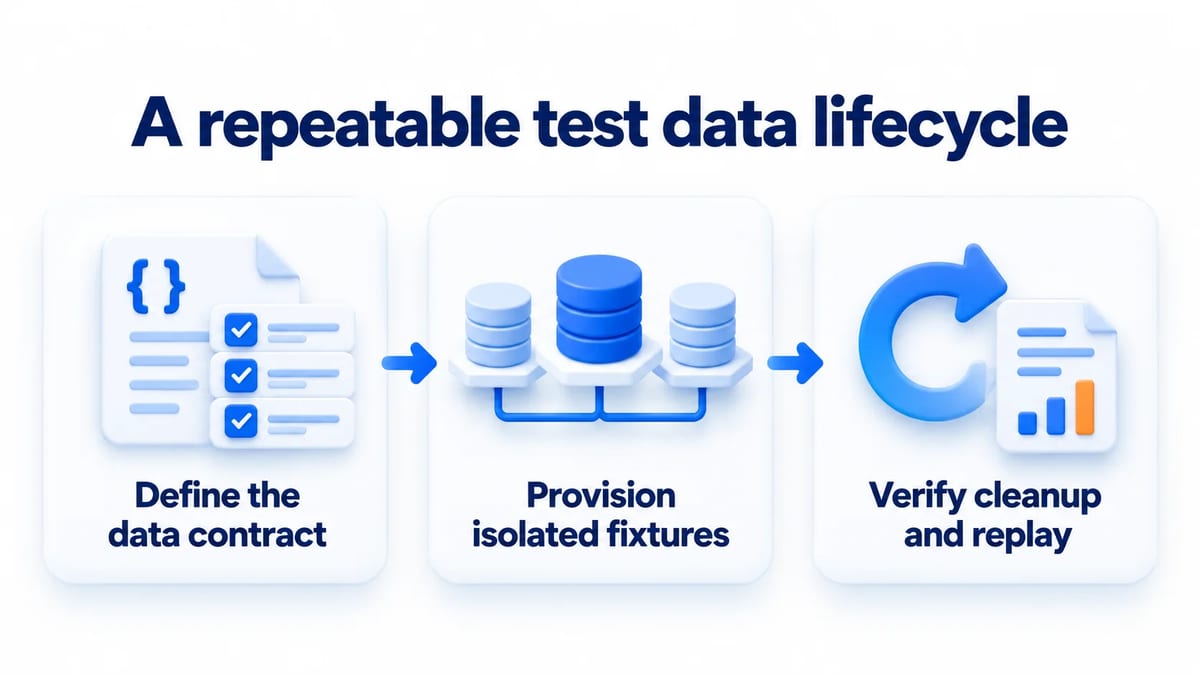
Carry one checkout scenario through setup and teardown
Define the data contract
Write the expected starting state alongside the test. The buyer is active, belongs to one tenant, and owns one pending order. The order uses the account's currency. A receipt job starts absent. Define the expected purchase result and identify the component responsible for every invariant.
Use the database's real constraints during fixture creation. PostgreSQL constraint documentation explains foreign keys, uniqueness, and checks. A foreign key establishes that an account exists. It does not automatically establish that the order belongs to the correct tenant. Add the appropriate schema relationship where supported and verify business rules in setup assertions. Keep constraints enabled so fixture defects fail early.
Version the builder with the schema it supports. Record a schema revision and a fixture recipe revision separately from the random seed. After a required currency field appears, setup should reject an incompatible recipe clearly. A seed cannot repair a changed schema or explain which defaults an older builder supplied.
Provision isolated fixtures
Allocate a unique run identity, then include the shard, worker, test identity, and attempt in each allocation. A worker number alone repeats across machines and later CI jobs. Generate the run identity independently of the seeded business data so two runs replaying the same seed cannot claim the same namespace.
For example, the application helper createCheckoutFixture({ allocationId, recipeVersion, seed, businessNow }) can return owned account and order identifiers. These are proposed helper parameters, not a library API. Persist ownership in a test resource ledger or a scope the application can enforce. Register allocations before provisioning so a partially completed setup remains discoverable.
Give fixture provisioning and cleanup separate identities with least privilege, restricted to approved nonproduction resources and the operations each needs. Follow OWASP database permissions guidance when granting database access. Enforce cleanup scope through permissions, such as access limited to the allocation's dedicated schema or a restricted deletion procedure that validates its scope. An ownership label alone cannot constrain a broadly privileged cleaner. Keep elevated setup credentials outside application journeys so permission checks exercise the intended application identity.
Give each parallel worker a separate mutable account. Reset that worker's scenario before every test, or allocate a fresh scenario for each test when resetting cannot exclude late writers. Playwright fixtures distinguish test scope from worker scope and pair setup with teardown around await use(). An account shared within one worker still needs a clean state between its tests.
Verify cleanup and replay
Place teardown in a finally path and make deletion safe to repeat for already absent resources. Stop new work for the allocation, then cancel or drain its queued work before removing durable records. Follow the application's deletion dependencies. A receipt worker that runs afterward can recreate records or send a message after teardown appears complete.
Query the owned scope after cleanup and record whether any rows, objects, or pending jobs remain. Preserve a failed cleanup as a separate failure even if the behavioral assertion passed. Test the cleaner by creating a fixture, cleaning it twice, and checking that an unrelated allocation survives both attempts.
Save the recipe inputs and source revision before discarding the fixture. Replay should create fresh identifiers with the same business relationships. Keeping the original allocation alive for debugging needs an explicit expiry and restricted access. It should never become the default starting state for the next run.
Match the test data management process to each writer
Know when transaction rollback applies
A repository test can begin a transaction, create its fixture, exercise code using that same transaction, and roll back afterward. PostgreSQL transactions provide atomic changes and rollback. Confirm that the code under test actually uses the supplied connection and transaction.
A browser request usually reaches a server connection outside the test transaction. Uncommitted setup may be invisible to that connection, and the server's committed writes will survive rollback in the test process. Use an isolated database, schema with correctly routed connections, or enforced tenant scope for these tests. Reset only resources exclusively owned by that boundary, including caches and search records when they affect results.
Separate browser isolation from account isolation
Playwright browser contexts isolate browser storage and cookies. Two fresh contexts can still authenticate as the same account and modify its server state. The authentication guide recommends separate accounts per parallel worker for tests that mutate shared server state.
Protect saved authentication state as a credential. That guide warns that state files can contain cookies and headers allowing impersonation. Keep them out of repositories and broadly shared reports. Generate state for the intended test identity, and check that its role and tenant match the fixture before starting the journey.
Reset data even when infrastructure stays running
A disposable database can bound ownership neatly, but starting it says nothing about the records later tests leave behind. The Testcontainers for Java lifecycle guide documents manual start and stop and shared container lifetimes. Match resource lifetime to the suite while resetting mutable scenario state independently.
Its experimental reuse documentation says reused containers remain running and are unsuitable for CI. If a local workflow uses reuse, require a known reset before loading the current recipe. A warm container with yesterday's rows is an uncontrolled input. Check the lifecycle semantics of your language binding before adopting Java examples elsewhere.
Control time and external effects
Distinguish business time from cleanup time
Define one reference instant for the checkout scenario. An event's occurrence time, ingestion time, and processing time can differ. If the rule accepts events less than a day old, construct cases immediately before, at, and after the exact boundary, with the equality behavior agreed in advance. Avoid making these records relative to the machine's current date.
The Playwright clock guide documents browser time controls, including page.clock.setFixedTime. That browser control does not set the server or database clock. Inject business time into the services evaluating expiry, and supply fixed reference dates to relative date generators. Faker's usage guide explains why a seed alone cannot stabilize those methods.
Use an independent operational clock for cleanup leases. A frozen business clock must not keep abandoned fixtures alive indefinitely. Store a lease expiry for each allocation and renew it while work remains active. A janitor should reclaim expired, inactive allocations and report failures. Time to live, or TTL, is a recovery mechanism for crashed runners; normal teardown should still verify removal.
Route payments and messages into dedicated test backends
Fail setup when configured endpoints or credential modes fall outside the approved test boundary. Use a fake payment backend for deterministic declines and a provider sandbox when evaluating the real integration. Stripe testing documentation describes sandbox transactions that do not move funds and requires test keys for test API calls. Keep the evidence from a fake distinct from evidence about a provider integration.
Route email into a capture backend with no delivery path. Assert the recipient and content there, using synthetic addresses. Namespace captured messages by allocation so one worker cannot satisfy another worker's receipt assertion. Apply the same ownership rule to webhook captures and object storage. Include those stores in cleanup, and deny live service destinations at the environment boundary.
Choose a test data management tool against the contract
Start with a fixture builder, a generator such as Faker for variable fields, and the test runner's fixture lifecycle. Add an allocation ledger and cleanup worker when resources outlive the runner. This combination may meet the team's needs while keeping recipes beside the application code. Name an owner for each component before adding more automation.
Evaluate a vendor product with the same checkout contract. Ask it to provision two independent allocations, preserve their relationships, replay one recipe under fresh identifiers, and reclaim a partially created fixture. Interrupt provisioning and cleanup deliberately. Check whether it reports remaining resources and can exclude an active allocation from reclamation. These checks evaluate data provisioning and recovery through observable behavior.
Inspect how the tool records versions, restricts access to sensitive data, and exposes failure evidence. Compare setup time and cleanup reliability under the data volume your testing process actually requires. More generated rows add little test coverage when they repeat the same state. Prefer a tool whose lifecycle guarantees your team can verify and maintain.
Diagnose test data quality and lifecycle challenges
Cover permissions with deliberately different identities
Create an owner, a restricted member, and a user outside the tenant when those distinctions affect checkout visibility. Give each identity the same otherwise valid purchase conditions so a rejection actually tests authorization. Assert both the returned denial and the absence of a durable order or receipt job.
Use the contract testing guide when fixture payloads must satisfy a consumer expectation. The Playwright testing guide explains how to connect that prepared state with a browser journey and durable outcome checks. Keep fixture setup from performing the action that the test is supposed to evaluate.
Check data integrity and provenance before changing assertions
Attach the allocation identity, recipe revision, schema revision, generator version and seed, business clock, environment identity, and build revision to a restricted failure record. Include expected setup invariants and the cleanup result. Store identifiers and relevant state transitions without dumping credentials or unnecessary payloads.
Separate a failed setup from a behavior failure. If the account never received its starting balance, repairing the checkout assertion hides the wrong defect. Reproduce the starting relationships first, then examine the action and delayed effects. When a parallel failure disappears alone, run the competing operations against their recorded scopes and look for shared resources that escaped allocation.
For a safe hosted build, request a BetaRoast feedback round to ask people whether a declined purchase or expired invitation explains what happened. BetaRoast collects human feedback. That feedback can reveal a confusing outcome, but it does not verify database isolation or cleanup. Turn a specific observation into an explicit scenario before expanding the fixture contract.
Frequently asked questions
What belongs in a test data management contract?
Specify the owner, required starting relationships, supported schema and recipe versions, mutation scope, and cleanup responsibility. Include the clock and external backend assumptions when they affect behavior. Return identifiers that assertions and teardown can both use.
Does masking make a dataset anonymous?
Masking selected values does not establish anonymity. Remaining fields or combinations can still identify people. Prefer minimal synthetic fixtures, and require a separate assessment for any approved derived dataset. Removing names alone is insufficient evidence.
Can parallel tests share one account?
Only when their operations cannot interfere through that account or its dependent resources. For mutable workflows, allocate separate worker accounts and reset state between tests, or create a fresh scenario each time. Separate browser contexts do not isolate server records.
What should happen when cleanup fails?
Report the failure with its allocation and remaining resources. Prevent that scope from entering another test, preserve restricted replay evidence, and let the expiry mechanism recover abandoned state. Investigate late jobs and omitted stores before trusting a passing rerun.
Give each fixture an owner, a versioned data contract, and an isolation boundary. Construct valid relationships, control business time, and route external effects into test backends. Preserve replay provenance and verify cleanup across durable records and delayed work before trusting another run.